


Couverts
Antique melon knives, in argent fourrré and gilt metal
Antique melon knives, in argent fourrré and gilt metal
Argent fourré & Métal doré
Maitre orfèvre :
Discover this melon knife service featuring the classic decorative motifs typical of antique silverware and tableware from the 19th and 20th centuries.
Composed of 12 pieces, the silver-lined handles are decorated with laurel leaves. The forked blades are made of gilded metal and are stained.
What is it?: The melon knife is a 2-in-1 utensil that allows you to both cut the flesh with its blade and enjoy the flesh with the curved fork.
Our opinion: This type of piece no longer exists today, and you could adapt it for other products, especially watermelons... 😋
Ideal for standing out from the crowd and showcasing your uniqueness with antique silverware!
Condition :
- Minor scratches due to age and use
- stained fork-blades
- partially blunted gilded metal
Weight & dimensions:
Weight :
Length :
Low stock: 1 left
Couldn't load pickup availability
Description du bien
Description du bien
Composition du bien
Composition du bien
Etat du bien
Etat du bien
Poids & Dimensions
Poids & Dimensions


We'll tell you more:
Materials
- Vermeil:
Vermeil is a thin layer of gold applied to sterling silver.
Clad silver
Clad silver is a shell of sterling silver ‘clad’ with another material such as wax or resin. Widely used during the 20th century, it was often moulded and decorated with patterns.
- Silver-plated metal
Silver-plated metal is a goldsmithing technique that involves applying a layer of silver to base metal.
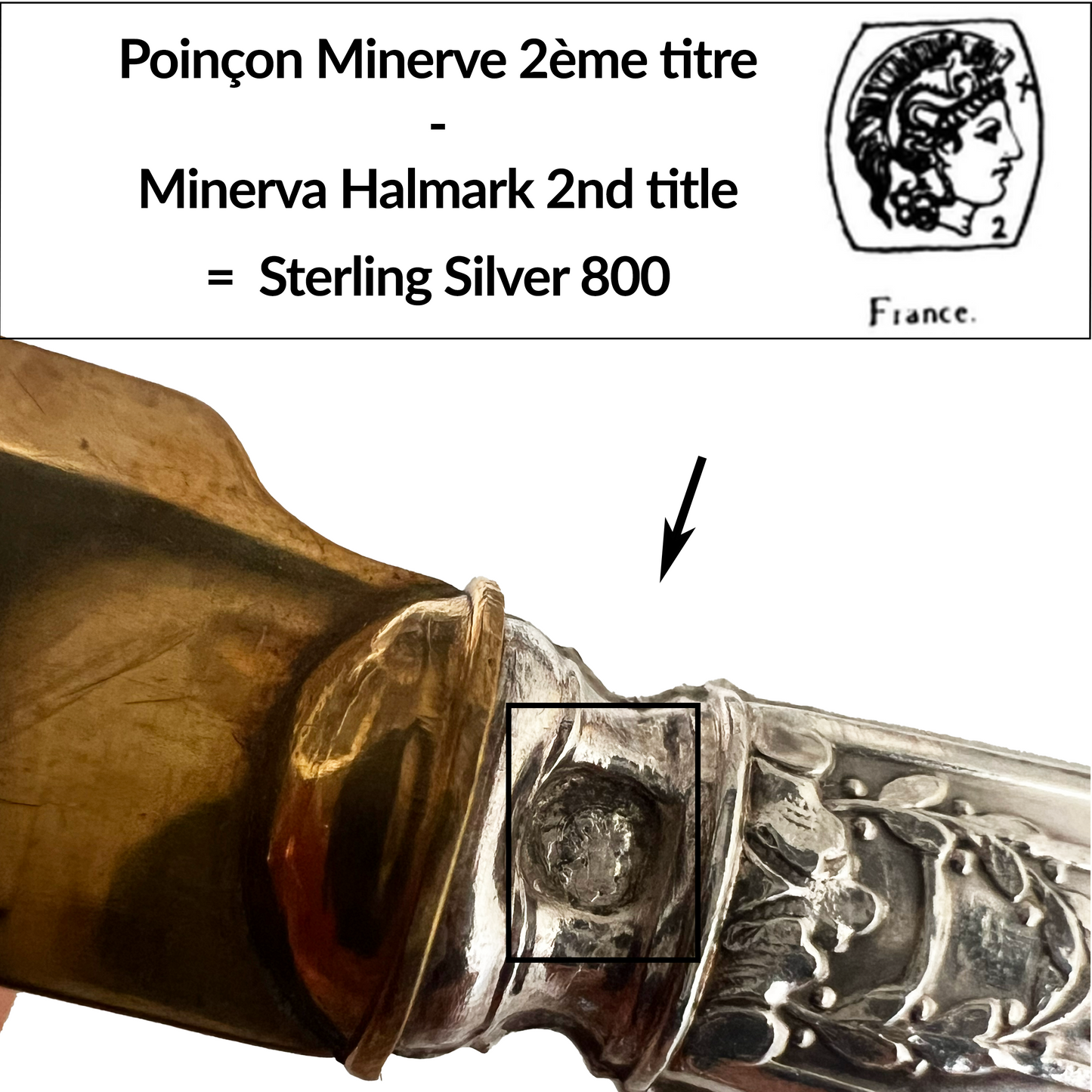
- The Minerva head hallmark
The Minerva head hallmark was introduced on 9 May 1838. It is used to mark silver items manufactured in France that have been tested using the wet method and recognised as being 950 thousandths (1st grade) or 800 thousandths (2nd grade) silver.
Minerva hallmark 1st fineness = 950 silver
Minerva hallmark 2nd fineness = 800 silver
- The Boar's Head hallmark
Boar's Head hallmark = Hallmark used between 1838 and 1973 for small silver items
- The Michelangelo Hallmark
The Michelangelo hallmark was stamped by the Paris Bureau on silver items recognised as 1st title (950 thousandths); introduced on 16 August 1819, it was abolished on 9 May 1838.
Michelangelo hallmark = 950 silver
- The Raphael head hallmark
The Raphael head hallmark was stamped by the Paris Assay Office on silver items recognised as 2nd title (800 thousandths); introduced on 16 August 1819, it was abolished on 9 May 1838.
Raphael's head hallmark = 800 silver
- The Facial Mask Hallmark
Facial mask hallmark = medium guarantee hallmark stamped on medium-sized silver items
Maintenance
No dishwasher, hand wash only